Normally I publish the articles after having had a good thought through everything. More of less. In case needed, I research longer and then start writing … but for this one I thought I would change the rule.
I will just let you be part of my thought process of how things usually develop in my brain. It may or may not be correct. But this is how I associate thoughts.
In order to read this, you need to understand that this is not a technical breakdown of kumite karate. I’m a karate student, not a kumite specialist. So, whatever I will be writing here … This is about my own thought process which leads to eventually what I use with my kids in school.
So welcome … follow me into the rabbit hole.
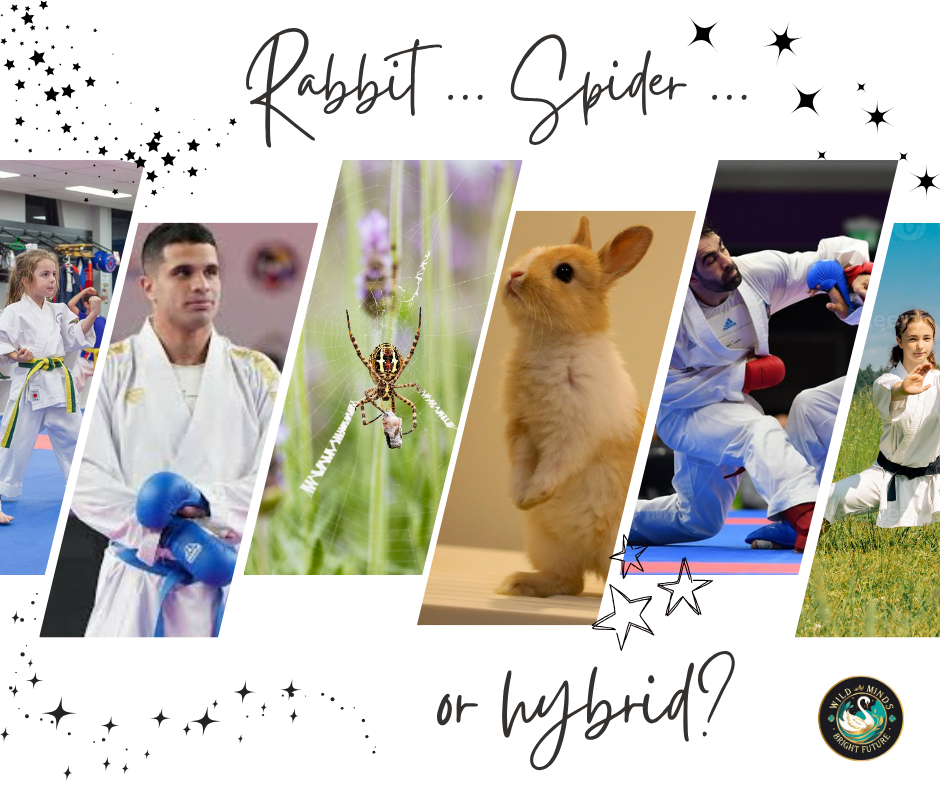
I was watching a kumite fight between two players and noticed that they were bouncing a lot. I call players that use this style a lot “rabbits” as they remind me of a video of a small child bouncing at a competition that was beyond cute. (https://www.youtube.com/watch?v=WUJhaDrYVsw)
While I watched them I got lost in my own thoughts which just continued to spiral down into their own little world.
I thought …how much energy must this bouncing take without actually striking or getting a point? But then again, no one would bounce and waste energy for the fun of it, so there must be a reason as to why they do this.
Then I thought of Youssef Badawi, one of my favorite active kumite players. I just love watching him play. For him I have the nickname “spider”. Different than the “rabbits” he often stands still and observes the other player. When the opponent just gives a slight sign of wanting to attack or giving an opening, he pounces with incredible force. Like a spider patiently waiting for its prey in its net and once its coming, they move with deadly attacks. (https://www.youtube.com/watch?v=3KMdCSq67rI&t=4s)
I think the reason why I love watching Youssef Badawi so much is the immense level of skill this requires and this in itself is interesting to see.
This technique is defined by stillness, extreme timing and the capacity of reading intention before movement is completed.
You need extremely well micro reading capacities of the entire body (face, shoulders, hips, breath, gaze …) and movement of your opponent. Kind of like hypervigilance … the smallest of movements will give you the sign when to pounce. You misread the sign, you are the one in trouble. You read it correctly, they have no chance.
And when watching a match with Badawi you can literally see how his eyes are locked in on the other person in oder to read them.
You need to have extremely high pattern recognition skills and emotional regulation to not reacting too early and a lot of confidence. In one word … this is containment and competence for me. Impressive to see.
But then also, he is not always winning (obviously), so the rabbits must also have something. And the more I thought about it …
Rabbits are high mobility. They constantly bounce, switch distance and create openings through movement and pressure. Like this they control the distance all the time, stay unpredictable and force reactions from the opponent. The energy they use by doing this seems to be an investment rather than waste. It looks like they are buying information and openings with their energy.
Both rabbit and spider styles have their pros and cons depending on situations but especially depending on skillset. Most high elite players seem to integrate both, yet you can often see a slight preference for one style, I feel like.
And all of that works…
until you come across this man …
Raphael Aghayev (https://youtu.be/pWa-f7gcyLc?si=x-pViB2fYockjQry) … a whole different category … neither rabbit nor spider.
Rather a category on his own … the “Greatest of all times” of kumite.
5 world championship titles, silver Olympic medal and many other titles …
He is the custom-built hybrid. He can pressure like a rabbit, counter like a spider and switch instantly. But that’s not all. When I saw his fights, I noticed that he is a lot closer to the opponent than others in general a lot of the time. I also noticed that he frequently loses his gloves. Because when he plays, he is constantly in the grey zone of what is admissible and what’s not. He seems to live right on the edge of the rules.
In WKF rules grabbing or holding means penalty. But momentary contact is tolerated. So elite fighters play in that grey zone, it’s normal. But with Aghayev, this becomes part of his style. He collapses distance fast, creates a moment of chaos and then either scores or resets. He breaks rhythm constantly, is very comfortable in messy, close-range exchanges and then uses contact, pressure and unpredictability like no other.
It just seems to be part of who he is. It looks very natural, almost chaotic, but actually controlled.
You see, opponents can prepare for a style (you often see rabbits turn into spiders when playing against a spider type opponent or the other way around, for example) but struggle to prepare against a person. A person that adapts mid-fight, constantly breaks expectations and forces opponents out of their comfort zone.
He doesn’t just play the game, he changes the conditions of the game.
The ones who stand out are rarely the ones who play safe. They are the ones who can move at the edge without losing control.
And this is where my thoughts moved away from karate on to my kids in school.
In karate just being a rabbit is not helpful, neither is just being a spider. Elite fighters integrate both styles … and the greatest of all combine all of it and add their own sauce to it. And isn’t that the same in real life?
We have the rabbits, the ones who need movement to think, who regulate through action, who are constantly in motion.
And we have the spiders, the ones who observe, who hold back, who process internally before they act.
Children often start with a dominant way of moving through the world.
But the goal is to make a hybrid like Raphael Aghayev. They can stay grounded. They can wait. And when the moment comes, they move. Not out of impulse. Not out of hesitation. But out of choice.
And in school, we often get it wrong. We try to make the rabbits still. And we try to make the spiders faster. But what if that’s not the goal? The goal is not to turn rabbits into spiders. And it’s not to push spiders into becoming rabbits.
The ultimate goal is to help each child expand their range. To help the rabbit find stillness without losing their energy. To help the spider find movement without losing their depth.
So that one day, they don’t react from habit but choose their own response. Just like the best fighters do.
Some move to understand. Some understand before they move. And the best… can do both.
The best gift you can give them is to teach them access to both. The highest level is not control, it’s flexibility within control.
Then I suddenly thought about the rabbits and one of the girls that is under my care. She is 6 years old, ADHD and severe dyslexia. Extremely smart, but she has great difficulties learning any symbols such as letters and numbers. Professionals have spent a lot of time on her without much success.
And I thought maybe I can use the rabbits to my advantage. If you look at this video, somewhere in the middle the children in the karate class are bouncing and then are told to jump into a ring with a certain colour.
https://www.instagram.com/reel/DWJi0jqAgzL/?igsh=eHF6cTBjcWJuN21i
The activity as it is in the video is already amazing for ADHD kids as it teaches reaction time, attention switching, motor control and impulse control as they must wait for the cue.
But I wanted to use this method even more. I bought rings like this and took them with me to school. Got her out of the class and took her outside to the play area.
She was intrigued by the rings and why I brought her there in the first place (obviously anything is better than sitting at a desk). I checked her understanding of the letters and noted the ones she had difficulties remembering.
I know from her IQ test that she is an extremely good visual learner … so I combined several things at once in this activity.
I started the activity like in the video. Then I combined two colours. So, she had to bounce into the first ring and then turn her body to bounce into the second row (memory, retaining 2 colours). Once she got comfortable with the movements I changed the colours with letters. I wrote the letters she had problems with on small pieces of paper, mixed them with some letters she knew well and stuck them to a ring each.
And then I had her jump into the rings with the letters I announced. She learned 2 letters that day. Because in her mind, now they were combined with movement, with a colour in the ring, plus the position of the ring.
She can use her visual memory to recall the letters, plus hearing my voice announcing the letters.
Now the letters were connected to movement… to space… to position… to sound.
She could see them. Feel them. Hear them. Experience them.
Multiple learning pathways were activated at the same time. The rabbit didn’t disappear, nor did it become a disadvantage. It became the way in.
You may think, why not just let them jump into a circle … the specific karate kind of bouncing does certain things in the brain that “just jumping” does not.
Repetitive movement like bouncing wakes up the nervous system and increases alertness. Especially for kids who struggle at a desk, movement means access to thinking
This kind of bouncing creates rhythm, and rhythm organizes the brain. The repetition and rhythm give predictability, reduces overwhelm and helps the brain stay regulated
It’s like the body creating a steady beat the brain can follow. So, I insisted that she would do the karate stances and bouncing before moving.
This activity in particular, by the way, prepares for switching, which so many ND kids have problems with …
When a child is bouncing and then must stop, listen and only then move, they are training attention shifting, impulse control and timing.
And this is exactly what I mean by expansion. Not removing the rabbit
but using it to build access to something more.
She was so happy that she could remember 2 difficult letters and was jumping happily back into her class that day.
So thank you, Youssef Badawi, Raphael Aghayev and the rabbits I saw in the videos that started the whole conversation in my head …

 Wild Minds - Bright Future
Leave a comment